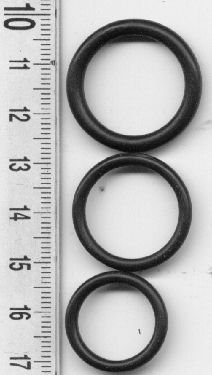
What is actually in a cylinder seal kit
"Seal kit" is used loosely by suppliers, and the difference matters when a cylinder is already apart on the bench. On an excavator boom, arm or bucket cylinder a complete kit covers every sealing component in that cylinder — not just the one that was leaking.
| Component | What it does | Symptom when it is worn |
|---|---|---|
| Rod seal | Primary dynamic seal between the pressurised oil and the outside world | Oil film or drip on the rod, dirt sticking to the rod |
| Buffer seal | Sits behind the rod seal and absorbs pressure peaks before they reach it | Rod seal fails early, repeatedly, always in the same machine |
| Wiper / dust seal | Scrapes mud, grit and water off the rod before it enters the gland | Torn lip, grit reaching the rod seal, scoring on the rod |
| Piston seal | Separates the cap side from the rod side on a double-acting cylinder | Drift under load, slow creep, lost holding power with no external leak |
| Wear / guide rings | Carry side load so the seals are not asked to do it | Metal-to-metal contact, oval bore marks, seals extruded |
| O-rings and backup rings | Static sealing at the gland and piston, plus anti-extrusion support | Weeping at the gland nut or piston, seals nibbled at the edges |
A kit that stops at the rod seal and wiper is a partial kit. If the cylinder is coming off the machine anyway, the labour is already spent — the cost difference between a partial kit and a complete one is small against the cost of pulling the same cylinder twice.
Materials: what each compound tolerates
Two kits can look identical in a photograph and behave completely differently in service, because the compound is what actually decides the temperature and pressure the seal survives. These are the typical published ranges for standard compounds — the data sheet for the specific compound in a given kit always governs.
| Compound | Typical temperature range | Typical hardness | Where it belongs | Weak point |
|---|---|---|---|---|
| NBR (nitrile) | −30 to +100 °C | 70–90 Shore A | O-rings, wipers, static sealing, general hydraulic service | Heat ageing above 100 °C; not for phosphate-ester fluids |
| PU (polyurethane) | −30 to +90 °C | 90–95 Shore A | Rod seals, wipers, high-abrasion circuits, mining and quarry machines | Hydrolysis — hot water, steam and damp storage attack it |
| PTFE | −200 to +260 °C | 55–65 Shore D | Buffer and backup rings, low-friction rod seals, high-pressure glands | Cold flow under load, so it needs a backup ring behind it |
| FKM (fluorocarbon) | −20 to +200 °C | 70–90 Shore A | Hot hydraulic circuits, chemical exposure, engine-adjacent cylinders | Cost, and poor performance in hot water and steam |
Practical consequence: a PU kit on a machine that runs hot and a NBR kit on a machine working in an abrasive quarry are both wrong choices, and both will be reported as "bad seals" rather than as a specification mismatch. Tell us the application — temperature, duty cycle, environment — and the compound can be matched to it.
The four measurements we need to quote a kit
Kits are built to the gland, not to the machine model. Two 320D excavators from different build years can carry different cylinder internals, so a model name alone is not enough to guarantee a fit.
- Bore diameter — the inside diameter of the cylinder tube, measured across the unworn section.
- Rod diameter — measured on an unworn band of the chrome, not where the wiper has polished a step.
- Stroke — from the cylinder's identification plate or the parts book; it identifies the cylinder variant.
- Cylinder part number — the stamped or cast number on the barrel or gland, which is the fastest route to the correct kit.
A photo of the identification plate plus the four numbers is enough for us to confirm a kit without guesswork. Measuring an old, deformed seal and quoting from that measurement is how a cylinder ends up with a kit that fits "almost".
Rod seal leak or piston bypass? The test that separates them
Both faults show up as "the cylinder is weak", and they need different parts. An external leak — oil on the rod, dirt collecting on the chrome — is the rod seal, wiper or gland O-ring. Internal bypass is a piston seal problem: the cylinder drifts under load, creeps when held, and gets slower as the oil heats up, but the rod stays dry. Hold the cylinder against a load for a few minutes with the engine off and watch the rod: movement with no external leak is bypass, and no amount of rod seal will fix it.
Why a kit rather than four seals bought separately
Seals in one cylinder age together, under the same oil, the same temperature and the same contamination. Replacing only the visibly failed seal leaves three others at the end of their life, and the second failure usually lands weeks later, on a machine that has just been pulled out of service. Add the labour, the oil, the crane and the downtime and the arithmetic is clear: the kit is the cheaper half of the job.
When a new seal fails in the first week
Most early failures are not seal failures at all. The common causes, in the order we see them: a scored or bent rod that cuts the new lip; an oval or bell-mouthed bore; grit left in the gland during assembly; the wrong compound for the oil temperature; and a blocked breather or return restriction holding back-pressure against the rod seal. Check those five before blaming the part — and if the rod is damaged, no kit will survive it.
Ordering
Send the machine model and serial, the cylinder position (boom, arm, bucket, outrigger, steering), the four measurements above and a photo of the old seals laid out flat. Kits ship from stock in 3–7 days, worldwide, FOB Shanghai or CIF. For fleets, order per machine rather than per seal: one kit box per cylinder is what keeps a service truck from arriving short.
FAQ
Q: What is included in a complete excavator cylinder seal kit?
A: A complete kit covers every sealing component in one cylinder: the rod seal, buffer seal, wiper or dust seal, piston seal, wear or guide rings, and the O-rings and backup rings for the gland and piston. Partial kits that stop at the rod seal and wiper exist and are cheaper, but if the cylinder is already off the machine they usually cost more in repeat labour than they save.
Q: Can you supply a seal kit from the machine model alone?
A: Usually not with certainty. Kits are built to the cylinder gland, and machines from different build years can carry different cylinder internals, so the model name is a starting point rather than a guarantee. Send the cylinder part number and the bore, rod and stroke measurements, and the kit can be confirmed before it ships.
Q: Why did my new rod seal start leaking within a week?
A: The seal is usually the victim rather than the cause. A scored or bent rod, an oval bore, grit left in the gland during assembly, the wrong compound for the oil temperature, or back-pressure from a blocked breather will all destroy a new seal quickly. Check the rod surface and the bore before fitting another seal, because a second kit will fail the same way.
Q: Should I choose polyurethane or nitrile seals?
A: Polyurethane is the better choice for abrasive, high-pressure duty such as mining and quarry machines, because it resists extrusion and wear far better than nitrile. Nitrile is the general-purpose option for O-rings, wipers and static sealing at moderate temperatures. Neither suits every application: polyurethane dislikes sustained heat above about 90 °C and hot water, and nitrile ages quickly above about 100 °C.